Two of You
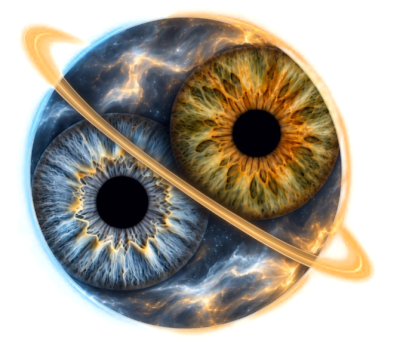
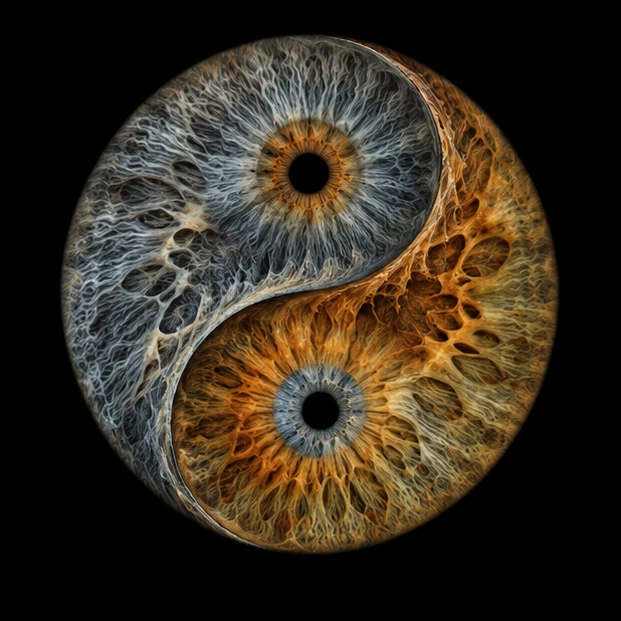
Put your irises side by side, curled into a yin yang or joined in one circle. Two patterns that will never exist anywhere else, together.
Your iris is the most detailed part of your face, and most people have never seen theirs. Here's a guided tour. Tap a number to see what you're looking at.
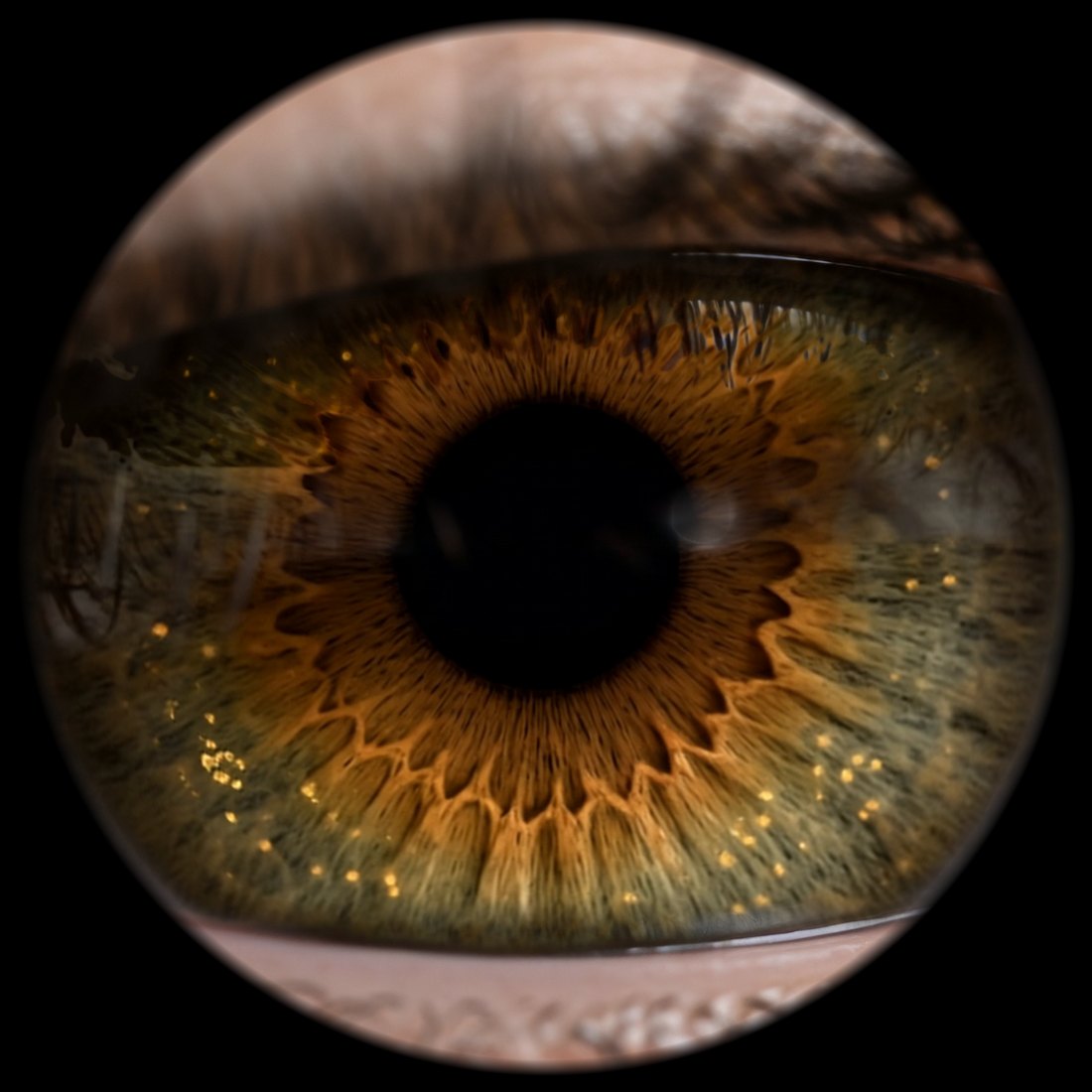 Example image
1 of 6
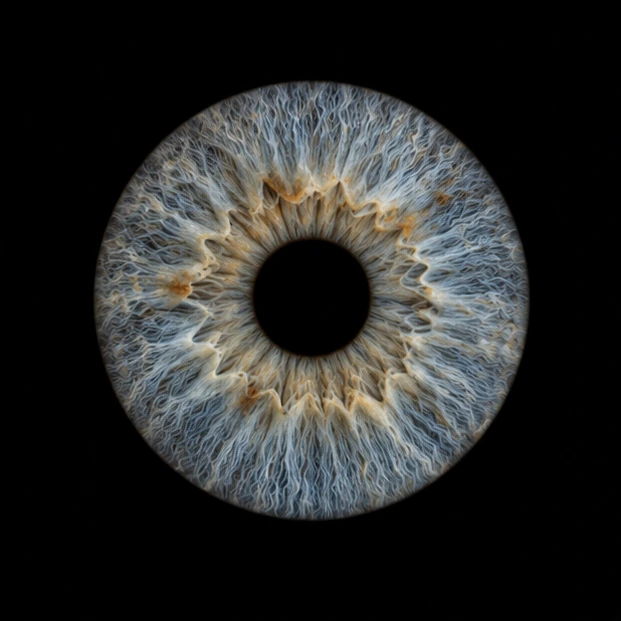
It isn't black. It's an opening, and it looks black because it's dark inside your eye. It widens in dim light and narrows in bright light, which slowly shapes the lines around it.
2 of 6
The zig-zag line that circles the pupil. It splits your iris into an inner and an outer zone, and its shape is different on every eye, even your own two.
3 of 6
The small diamond-shaped openings near the collarette, like tiny windows into the deeper layers. Some eyes have many, some almost none.
4 of 6
The curved lines toward the outer edge. They form as the pupil opens and closes, a little like the folds in a curtain.
5 of 6
Yes, eyes can have freckles. Small spots of pigment that catch the light, and a favorite detail in a close-up print.
6 of 6
This eye is hazel: some brown pigment plus the same light scattering that makes the sky look blue. Two ingredients, endless mixes.
Find your iris twin: tap the iris below that looks most like yours, or pick your color. You'll get a just-for-fun reading, the real reason your eyes are that color, and what the few actual studies have found.
Think of it like a horoscope: fun to read, not a rule. Your eye color doesn't decide who you are.
The Earth Keeper
Grounded, warm and steady. You are the friend people call first, the one who remembers birthdays and shows up with snacks. You trust slowly, but once you do, it is for life.
The most common eye color in the world, up to about 79% of people. Brown eyes have plenty of melanin in the front layer of the iris, which absorbs light and gives that warm, deep tone.
In a Czech study, people rated brown-eyed faces as more trustworthy than blue-eyed ones, although the researchers traced it to face shapes that tend to go with brown eyes, not the color itself. An Australian study of people with Northern European roots found darker-eyed people described themselves as more agreeable and helpful.
The Sky Watcher
Curious, independent and a little competitive. You like to figure things out for yourself, you notice what others miss, and you never quite stop wondering what is over the next hill.
There's no blue pigment in a blue eye at all. The front layer has very little melanin, so light scatters inside it the same way it does in the sky. The blue is made by light.
Blue eyes are new in human history. Researchers think they appeared only about 6,000 to 10,000 years ago. The same Australian study found that light-eyed people of Northern European descent scored as a bit more competitive than dark-eyed people.
The Wild Card
Creative, magnetic and hard to predict. You bring the spark to a room, chase new ideas, and keep people guessing in the best way.
A mix: a small amount of brown pigment plus that sky-like scattering of light. Together they read as green, and it is one of the rarest eye colors in the world.
No real studies on this one yet, so enjoy the reading above just for fun.
The Shape-Shifter
Easygoing and adaptable. Like your eyes, which can look brown one day and green the next, you fit into any crowd and read a room in seconds.
Brown and green in the same eye, often brown near the pupil and green toward the edge. Hazel can look different in different light, which makes it a fun one to photograph.
No real studies on this one yet, so enjoy the reading above just for fun.
The Storm Reader
Calm, observant and quietly wise. You listen more than you talk, and when you do speak, people lean in.
Fewer than 1 in 100 people. Gray eyes have very little melanin, and the way their front layer scatters light gives a soft silver tone instead of blue.
No real studies on this one yet, so enjoy the reading above just for fun.
Your eye color is your sign. Pick it for today's forecast, your ruling planet, lucky number and the sign you get along with best. A new reading every day.
Made up by us, purely for fun.
This one has a real study behind it. In 2007, researchers in Sweden photographed the irises of 428 students and gave them a personality test. People with more crypts, the little diamond-shaped openings, tended to score higher on warmth, trust and positive feelings. People with stronger furrows, the curved lines near the edge, tended to score higher on impulsiveness.
It was one study and the links were small, so don't read your future in it. But it's a fun thing to look for once you have your own print: count your little windows.
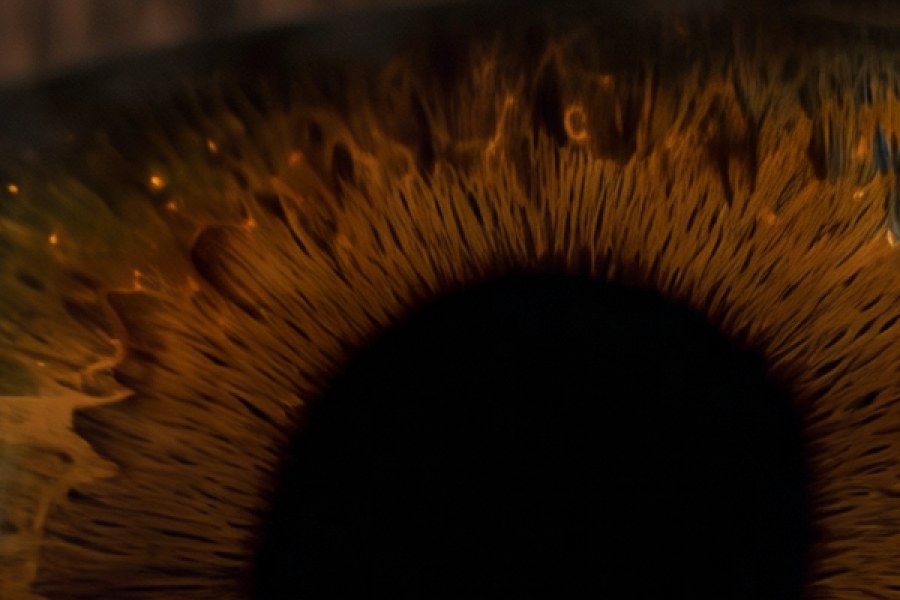
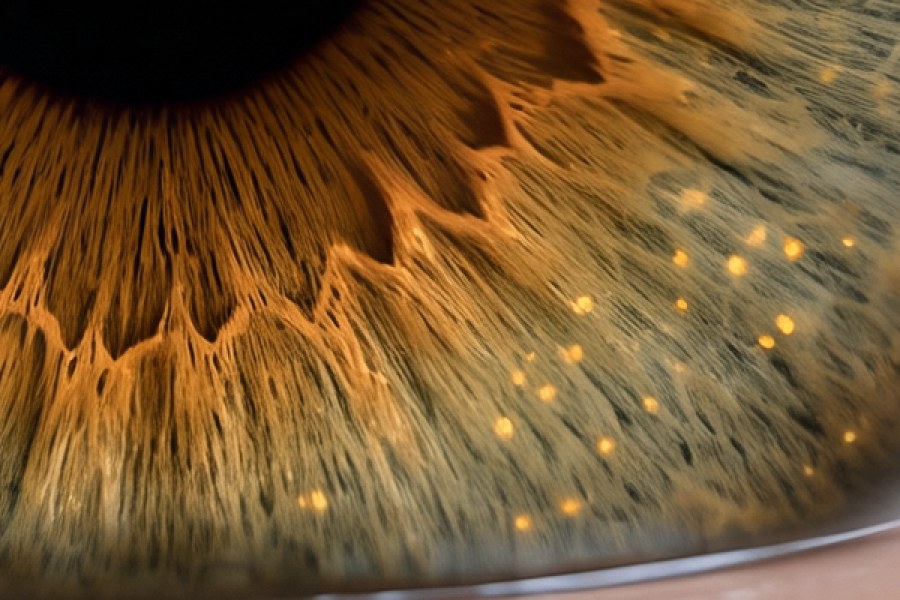
Example close-ups.
More detail than a fingerprint. Iris scanners check over 200 identifying points. Fingerprint systems use around 40.
Your two eyes don't even match. Your left and right iris form separately, so they're as different from each other as two strangers'.
Twins too. Identical twins share their DNA, but not their irises.
Finished before you were born. The pattern forms in the womb and stays with you for life. The iris you photograph today is the one you'll always have.
Baby eyes are still deciding. Many babies start with light eyes, and their color usually settles somewhere between 3 and 6 months, sometimes later.
Named for a rainbow. Iris was the Greek goddess of the rainbow.
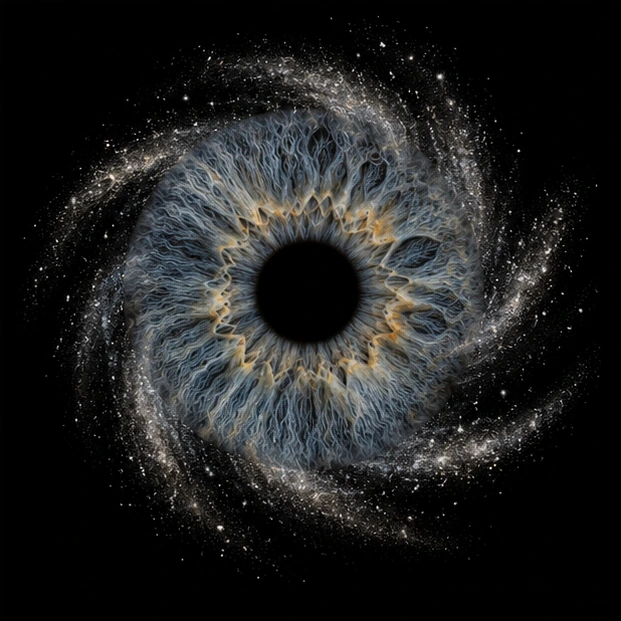
As the old saying goes, the eyes are the window to the soul. Nobody knows who said it first. The idea is older than anyone can trace, and the King James Bible puts it this way: "The light of the body is the eye."
Science has a little to say about it too. Researchers at Yale found most people instinctively feel that their "self" lives just behind their eyes, and research at Cornell found the eyes carry most of what a face tells us about feelings. That may be why seeing your own iris up close feels so personal.
An iris print is a piece of someone you can hang on the wall.
Put your irises side by side, curled into a yin yang or joined in one circle. Two patterns that will never exist anywhere else, together.
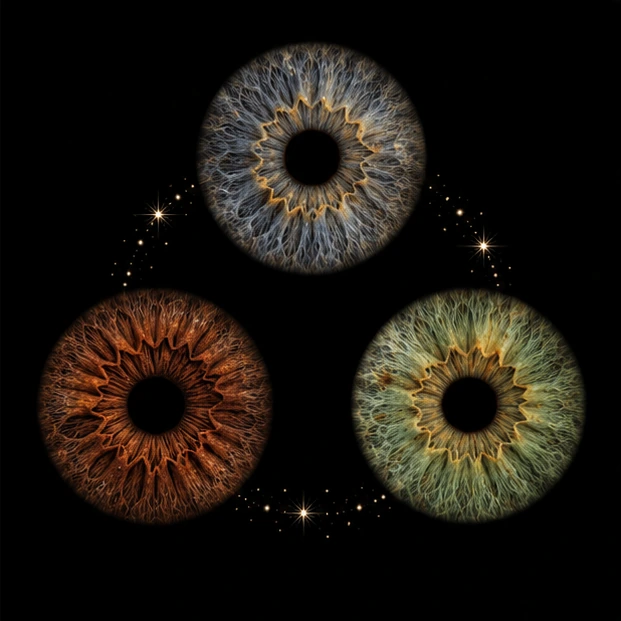
Grandparent, parent and child in one print. Three irises, each completely different, from one family. Ask us about bringing everyone in together.
Grandparents, parents, a partner. Their eyes, kept close every day. A gift session is an easy way to give it, and the photo itself takes only a few minutes.
Ask about a gift sessionNo. It's a quick, normal camera flash with soft light. If you have epilepsy, light sensitivity or recent eye surgery, check with your doctor first and tell us before your session.
The photos take just a few minutes, and you see your iris on the screen right away. Plan on about 15 minutes in all.
Skip them that day if you can. Contacts and mascara flakes can show up in a close-up.
Yes, as long as they can hold still for a moment. A parent or guardian stays with them.
No, and we don't try. Eye doctors don't support reading health from the iris. We make art, not medical claims.
Ask us about sizes and materials at your session. Every print is made from your own photo.
A few minutes in front of the camera, and you'll see a part of yourself you've never seen before.